

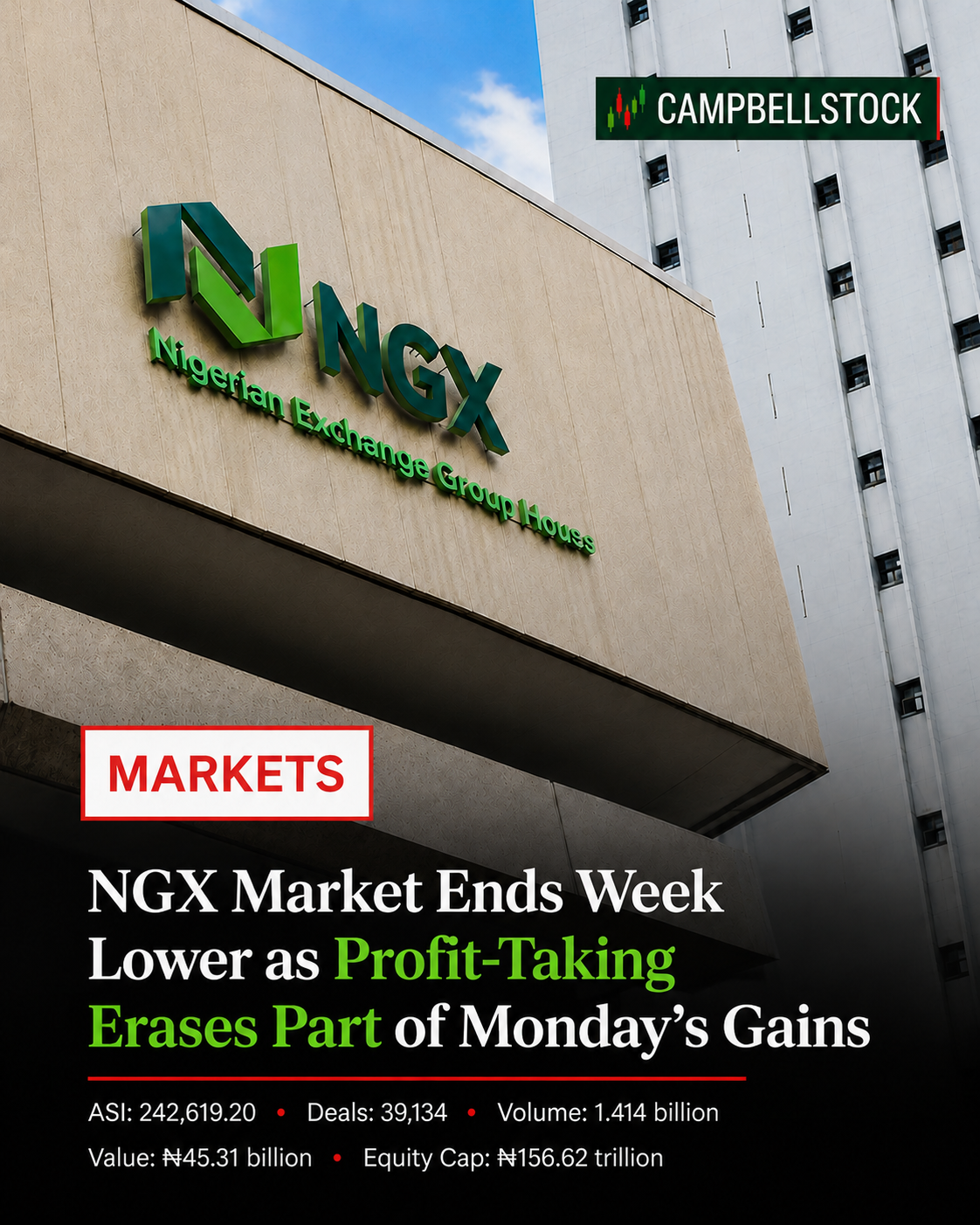
Nigerian equities ended the week ended August 14, 2026, on a weaker note as investors locked in profits after the market briefly pushed its capitalisation above ₦160 trillion. The decline came despite a sharp increase in trading activity, highlighting a market in which investors remained active but increasingly selective.
The Nigerian Exchange (NGX) All-Share Index (ASI) closed Friday at 242,619.20 points, down 1.20% from 245,573.07 points at the end of the previous week. Market capitalisation also fell to approximately ₦156.62 trillion, according to NGX data. Despite the weekly setback, the ASI remained strongly positive for the year, with a 55.91% year-to-date gain as of August 14.
The week began with strong buying interest. On Monday, the ASI climbed to 248,529.75 points, while equity market capitalisation crossed the ₦160 trillion mark for the first time, reaching about ₦160.42 trillion.
That early strength, however, proved difficult to sustain. Investors began taking profits in highly capitalised stocks, sending the benchmark lower for several consecutive sessions. By Thursday, the market had already lost about ₦3.54 trillion in capitalisation from Monday's level, with the ASI falling to 243,017.38 points.
The selling continued into Friday. The ASI slipped another 0.16% to finish at 242,619.20 points, bringing the market's decline from Monday's peak to roughly 2.38%. The pattern suggests that the week's weakness was largely a profit-taking correction rather than a complete reversal of the broader bullish trend. After the substantial gains recorded earlier in the year, some investors appear to have used the new highs as an opportunity to realise profits.
According to the NGX, investors traded 12.153 billion shares worth ₦176.06 billion in 224,146 deals during the week. Trading volume increased by 126.8% from the previous week's 5.359 billion shares, while turnover value rose 26.6% from ₦139.05 billion.
The rise in volume while the index declined is significant. It indicates that the market was not simply quiet or abandoned by investors. Instead, substantial transactions were taking place as investors repositioned portfolios and took profits in some stocks.
The Financial Services sector dominated activity, accounting for 11.212 billion shares worth ₦88.99 billion. The sector represented more than 92% of total equity turnover by volume and about half by value.
Three stocks Fortis Global Insurance, Cornerstone Insurance and Consolidated Hallmark Holdings were particularly responsible for the heavy volume, together accounting for 9.488 billion shares traded during the week.
The market recorded 39,134 deals, with about 1.414 billion shares changing hands and a total transaction value of approximately ₦45.31 billion. Equity market capitalisation stood at about ₦156.62 trillion.
The day's strongest performers included Intense Energy Insurance, Trans-Nationwide Express, Guinea Insurance, Regency Alliance Insurance and Japaul Gold.
Intense Energy Insurance led the Friday gainers, rising from ₦4.84 to ₦5.32, a 9.92% increase. Trans-Nationwide Express gained 9.65%, while Guinea Insurance, Regency Alliance Insurance and Japaul Gold rose 6.67%, 6.25% and 5.36%, respectively.
On the other side of the market, FTGINSURE was among the day's biggest decliners, falling 9.31% from ₦2.90 to ₦2.63. Omatek declined 9.04%, John Holt lost 9.00%, RT Briscoe dropped 7.94%, while Dangote Sugar fell 7.79%.
These Friday figures should be viewed as single-session performance, rather than the performance of the stocks for the entire week. The broader weekly data show that Trans-Nationwide Express and International Energy Insurance were actually among the strongest stocks for the full week, gaining 32.09% and 31.68%, respectively.
The 55.91% year-to-date gain means that the market's August pullback has done little to erase the substantial returns accumulated since the beginning of 2026. Some major sector indices have performed even more strongly. As of August 14, the NGX Oil and Gas Index was up 94.81% year-to-date, while the Premium Index had gained 85.14% and the Industrial Goods Index 82.84%.
This helps explain why profit-taking became more pronounced during the week. After such strong gains, investors have greater incentives to lock in returns, particularly when the benchmark reaches new highs.
The market therefore enters the new week with two competing forces. On one side is the continued strength of the Nigerian equities rally and investors' appetite for selected stocks. On the other is the risk that elevated valuations and accumulated gains could encourage further profit-taking.
For investors, the key question is no longer simply whether the NGX is rising. The more important issue is which stocks can continue to justify their valuations through earnings, fundamentals and future growth prospects.
The week ended August 14 consequently represents a period of consolidation for the Nigerian market: the benchmark fell, but trading activity surged, selected stocks continued to rally, and the broader bull-market gains remained firmly intact.


Comments (0)
You must be logged in to post comments.
No comments yet. Be the first to start the conversation!