
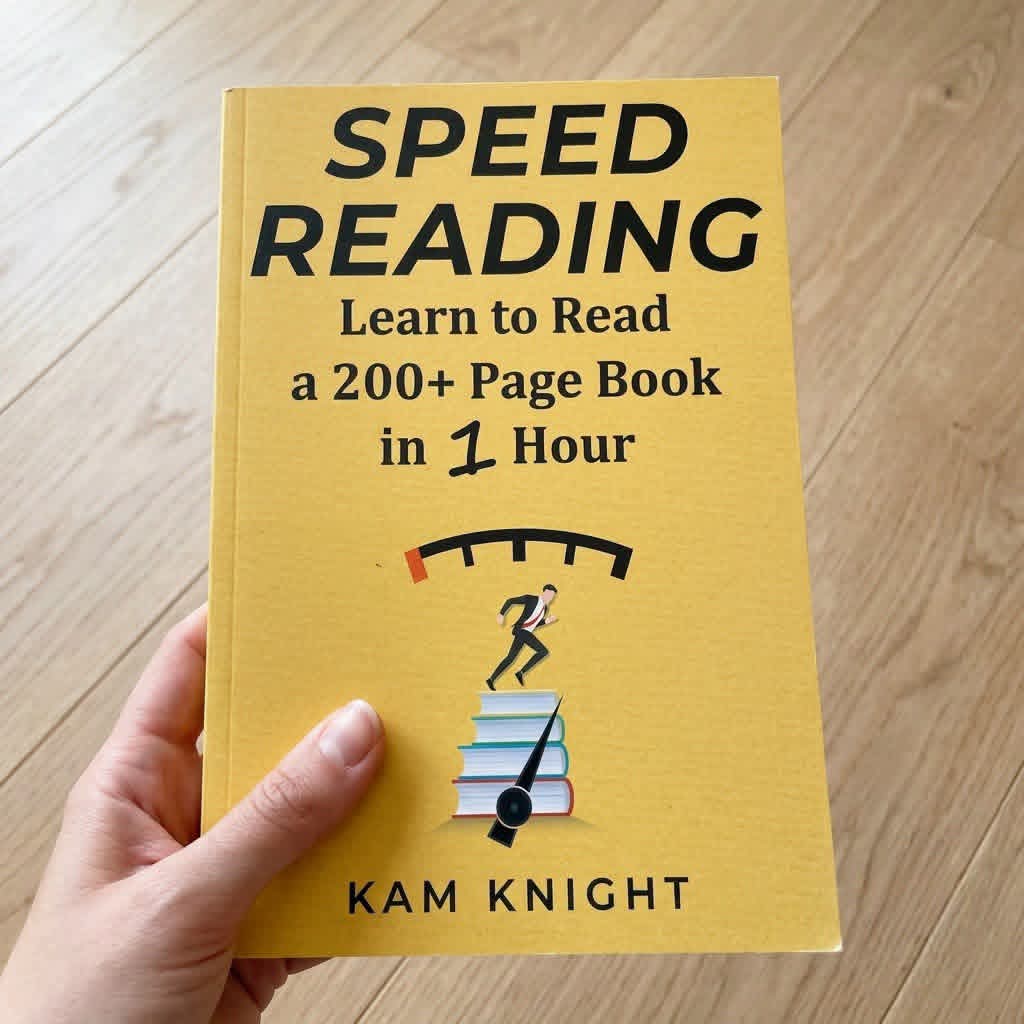
Speed Reading
Speed Reading teaches you to read smarter, faster, and with greater focus by improving eye movement, reducing subvocalization, and learning to extract the most important ideas efficiently.
We live in a world overflowing with information, yet many of us still read using the same habits we learned as children. Kam Knight's Speed Reading challenges the idea that reading faster simply means moving your eyes more quickly. Instead, it presents speed reading as a skill that combines eye movement, focus, comprehension, and smarter information processing. If you have ever looked at a pile of books, reports, or articles and wished you could absorb them faster, this book offers practical techniques for turning reading into a more efficient and intentional skill.
Here are four lessons that stayed with me.
1. Break the Habit of Subvocalization, Stop Hearing Every Word
One of the biggest obstacles to faster reading is subvocalization, the habit of silently pronouncing words in your head as you read them.
Knight explains that when we mentally "say" every word, our reading speed can become tied to the pace of speech. Instead, the goal is to train your brain to recognize words, phrases, and ideas visually rather than processing everything through an internal voice.
The shift is simple but powerful: stop treating reading like listening and start treating it like seeing.
With practice, your eyes and brain can begin recognizing groups of words and extracting meaning without needing to mentally pronounce every single one.
2. Train Your Eyes to See More at Once
Slow reading is often connected to inefficient eye movements. Our eyes naturally move across a page through a series of jumps and pauses, but many readers make far more movements than necessary and frequently move backward to reread material.
Knight introduces techniques such as using a finger, pen, or other visual pacer to guide your eyes across the page. This encourages smoother movement and helps reduce unnecessary regressions.
He also emphasizes the potential of peripheral vision. Instead of focusing intensely on one word at a time, readers can gradually learn to take in groups of words and larger sections of text.
The result is a different way of reading: less word-by-word, more idea-by-idea.
3. Learn to Read Selectively
Perhaps the most important lesson is that you don't always need to read every word to understand the message.
Different parts of a book have different levels of importance. Headings, introductions, conclusions, chapter summaries, and opening sentences often reveal the structure and central arguments of a text.
Knight encourages readers to identify this "skeleton" before spending time on the details.
This doesn't mean skipping important information. It means becoming intentional about where you place your attention. A good reader learns to distinguish between information that deserves deep concentration and information that can be scanned quickly.
That idea completely changes the question from "How fast can I read this book?" to "How efficiently can I extract what I actually need from this book?"
4. Adjust Your Speed and Practice Your Reading Muscle
Speed reading is not about maintaining one maximum speed for everything you encounter. A complex scientific paper, legal document, or technical manual may require careful, slower reading, while a familiar article or straightforward chapter can be processed much more quickly.
Knight emphasizes the importance of adjusting your reading speed to match the material and your purpose.
But faster reading also requires practice. Just as physical skills improve through repetition, reading efficiency improves when you consistently train your eyes and brain through focused exercises.
The goal isn't simply to read quickly.
The goal is to find the fastest speed at which you can still understand, retain, and use the information that matters.
Key Takeaway
Speed Reading is ultimately less about racing through books and more about becoming a smarter reader. Knight's techniques encourage us to break inefficient habits, improve visual processing, eliminate unnecessary rereading, and become more selective about where we invest our attention.
If you regularly deal with books, reports, research, emails, or endless online information, the skills in this book can help you approach reading with greater speed and intention.
Because in an information-heavy world, the advantage isn't simply having access to more information, it's being able to process the right information efficiently.
Book/Audiobook: Speed Reading on Amazon/Audible
You can access the audiobook when you register on the Audible platform using the link above.
Disclosure: This review reflects my personal thoughts and takeaways from The Whole-Brain Child. The audiobook link provided may be an affiliate link, meaning I may earn a small commission if you make a purchase or sign up through it, at no additional cost to you.
You Might Also Like