
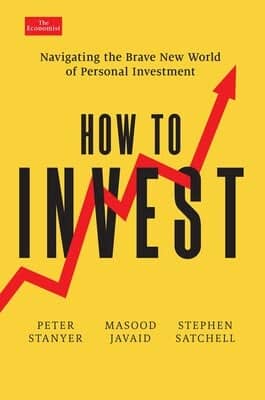
How to Invest: Navigating the Brave New World of Personal Investment
How to Invest is a practical guide to navigating modern financial markets through diversification, disciplined asset allocation, risk awareness, and informed decision-making.
Its core message is simple: successful investing is less about predicting the market and more about building a sensible strategy you can understand and stick with.
In How to Invest, published in association with The Economist, Peter Stanyer, Masood Javaid, and Stephen Satchell offer a practical and intellectually grounded guide for anyone trying to make sense of today's investment world. Rather than promising quick wins or presenting investing as a game of predicting the next big stock, the authors focus on the fundamentals: asset allocation, risk management, diversification, and keeping costs under control.
What makes this book particularly valuable is its ability to cut through the noise. Investing can often feel like an endless stream of market predictions, financial jargon, and promises of extraordinary returns. This book brings the conversation back to what investors can actually control.
Here are three lessons that stood out to me.
1. Asset Allocation Matters More Than Trying to Pick Winners
One of the strongest messages in the book is that where you put your money matters enormously.
Instead of spending all your energy trying to identify the next winning stock or predict exactly when the market will rise or fall, the authors emphasize deciding how your portfolio should be divided among different asset classes such as equities, bonds, real estate, and cash.
This is a powerful shift in perspective because it moves investing away from prediction and toward strategy.
You may not be able to control what the market does tomorrow, but you can control how much risk you are willing to take and how your money is distributed across different investments.
The lesson is simple: build the right portfolio before worrying about finding the perfect investment.
2. Risk Is Not the Enemy, Not Understanding It Is
Investing always involves risk. The goal isn't to eliminate risk completely; it is to understand it well enough to make informed decisions.
The authors encourage investors to think beyond the possibility of losing money and consider how different investments behave under different market conditions. Volatility, inflation, interest rates, liquidity, and the possibility of permanent capital loss all matter.
This is especially important because investors often discover their true tolerance for risk only after the market falls.
A portfolio may look perfect when markets are rising, but the real test comes when prices drop and fear takes over.
That is why one of the most valuable investing questions isn't "How much can I make?" but "How much risk can I realistically live with?"
3. Control What You Can: Costs, Diversification, and Discipline
Perhaps the most practical lesson is that successful investing is not always about doing something clever. Sometimes, it is about avoiding unnecessary mistakes.
Investment fees, trading costs, taxes, and other expenses can quietly reduce long-term returns. At the same time, concentrating too much money in one investment or sector can expose a portfolio to risks that could have been reduced through diversification.
The authors' framework encourages investors to focus on the things within their control: keeping costs reasonable, diversifying appropriately, maintaining a suitable asset allocation, and avoiding emotional decisions.
And this is where investing becomes less about intelligence and more about discipline.
You don't necessarily need to predict every market move. You need a strategy you can understand, afford, and stick with through different market cycles.
How to Invest is a thoughtful guide for investors who want to replace market noise and speculation with structure, discipline, and informed decision-making.
Its central message is one worth remembering: successful investing is less about predicting the future and more about building a portfolio that can survive and grow through an uncertain one.
Book/Audiobook: How to Invest
The audiobook can be accessed through Audible using the link above.
Disclosure: This review reflects my personal thoughts and takeaways from How to invest. The audiobook link provided may be an affiliate link, meaning I may earn a small commission if you make a purchase or sign up through it, at no additional cost to you.