
Financial markets include several different markets, each serving a specific purpose. These include the capital market, money market, foreign exchange market, and derivatives market.
Financial markets play an important role in connecting investors with businesses and governments that need funding. Two major components are the capital market and the money market, which differ mainly in the maturity and purpose of the financial instruments traded.
Capital Market
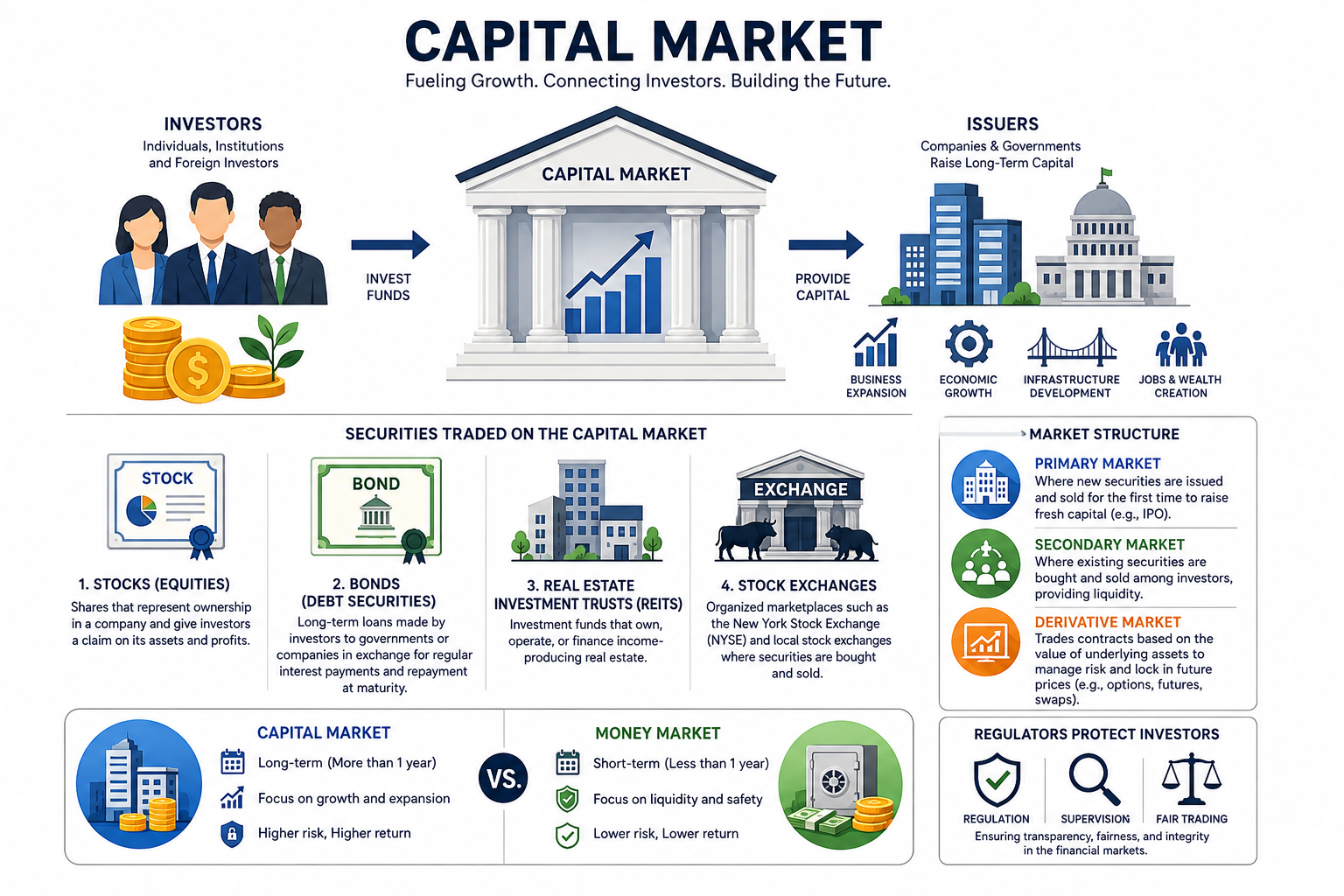
A capital market is a financial marketplace where buyers and sellers trade long-term financial assets such as stocks and bonds.
It provides opportunities for individuals and institutions that are willing to invest over the long term to channel funds through financial intermediaries to companies and governments that require long-term financing.
This system helps businesses expand, supports economic growth, and finances public infrastructure and development projects.
The following securities and financial instruments are commonly associated with the capital market:
- Stocks (Equities): Shares that represent ownership in a company and may give investors a claim on its assets and profits.
- ```
- Bonds (Debt Securities): Long-term debt instruments through which investors lend money to governments or companies in exchange for interest payments and repayment of principal according to the terms of the bond.
- Real Estate Investment Trusts (REITs): Investment vehicles that own, operate or finance income-producing real estate.
- Stock Exchanges: Organized marketplaces where securities are bought and sold, such as the New York Stock Exchange and other national or regional exchanges.
- ```
Money Market
The money market is a financial market where short-term funds and short-term financial instruments, generally with maturities of one year or less, are issued and traded.
In other words, it provides an avenue for suppliers and users of funds to meet short-term financing and investment needs through instruments such as:
- Treasury bills
- Treasury certificates
- Commercial paper
- Certificates of deposit
- Bankers' acceptances
- Repurchase agreements
Money market instruments are generally characterized by short maturities and high liquidity. However, the level of risk varies depending on the instrument and issuer.
How the Capital Market Is Structured
The capital market can be broadly divided into two major segments:
- Primary Market
- Secondary Market
Derivatives are also an important part of modern financial markets, although they differ from traditional capital-market securities because their value is derived from an underlying asset, security, rate or index.
1. Primary Market
The primary market is where companies or governments issue and sell new securities to investors. It is the market through which issuers raise new capital.
One example is an Initial Public Offering, through which a company offers shares to the public for the first time.
In Nigeria, the Securities and Exchange Commission is the principal regulator of the Nigerian capital market and plays a central role in regulating securities offerings and market participants.
Related Article
```The Complete Beginner's Guide to Investing
New to investing? Explore the fundamentals of investing, financial markets, investment concepts and the basic principles beginners should understand.
```Functions of the Primary Market
- Facilitating the issuance and sale of new securities to investors.
- ```
- Providing companies and governments with access to new sources of capital.
- Supporting the registration and disclosure requirements associated with securities offerings.
- Establishing a framework for the orderly issuance and distribution of securities.
- Supporting investor protection through securities regulation and disclosure requirements.
- Providing a mechanism through which companies can raise capital for expansion, investment and other corporate purposes.
- ```
2. Secondary Market
The secondary market is where investors buy and sell securities that have already been issued. Instead of purchasing securities directly from the issuing company, investors trade with other investors.
It can therefore be described as an investor-to-investor market.
Secondary-market transactions provide liquidity because investors can buy or sell existing securities rather than having to hold them until maturity or until the issuer repurchases them.
In organized securities markets, investors typically conduct transactions through licensed brokers and other authorized market participants.
Note: Financial instruments issued in both money markets and capital markets may have secondary markets. However, the way these instruments are traded depends on the type of instrument, market structure and applicable regulations.
Functions of the Secondary Market
- Provides a marketplace for previously issued securities.
- ```
- Provides liquidity by allowing investors to buy and sell existing investments.
- Helps facilitate the discovery of market prices for traded securities.
- Can encourage broader participation and ownership of publicly traded securities.
- ```
The Derivatives Market
The derivatives market involves financial contracts whose value is derived from an underlying asset, security, interest rate, exchange rate, commodity, index or other reference variable.
Derivatives can be used for different purposes, including hedging financial risks and managing exposure to changes in prices, interest rates or exchange rates. They can also be used for investment and other financial strategies.
Examples of derivatives include:
- Options
- Futures
- Swaps
- Rights and other derivative-related contracts
Capital Market vs. Money Market
Although both are components of the broader financial system, the capital market and money market serve different purposes and generally involve different types of financial instruments.